
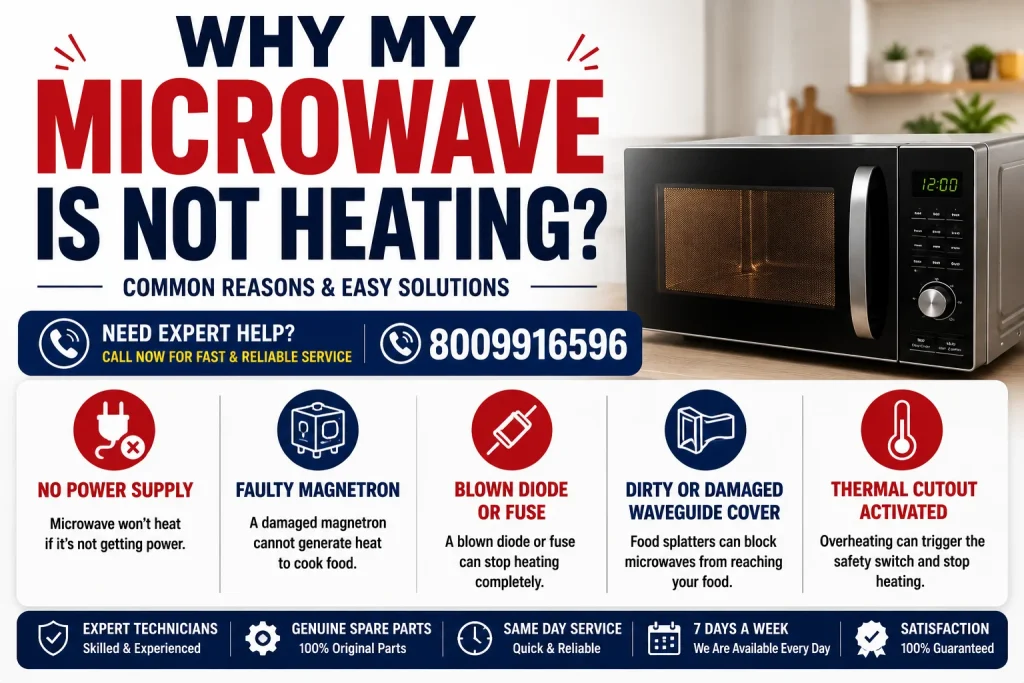
Why Microwave Is Not Heating
When a microwave suddenly stops heating, it can be frustrating because the appliance may still look completely normal. The display works, the interior light turns on, the turntable rotates, and the timer counts down—but the food remains cold. If you are searching for the reason behind Why Microwave Is Not Heating, the actual problem may be related to the heating system, door mechanism, power supply, settings, or an internal electronic component.
Microwave problems should not be diagnosed by guessing. In appliance repair work, it is common to find customers assuming that the magnetron has failed when another component is actually responsible. Understanding Why Microwave Is Not Heating requires looking at the complete heating system and the symptoms the appliance is showing.
This guide explains the common causes, practical checks, safety considerations, and situations where professional microwave repair is the right option.
Why Microwave Is Not Heating Even Though It Is Running?
A microwave can continue to run even when the heating section has developed a fault. The turntable, display, timer and interior light are separate functions from the system responsible for heating food.
Therefore, when someone asks Why Microwave Is Not Heating while everything else appears normal, attention usually turns towards the heating circuit and its supporting components.
The exact diagnosis depends on the microwave model. Traditional models and inverter microwaves can have different internal designs, so the same symptom may have different underlying causes.
Incorrect Cooking Mode or Power Setting
Before considering a technical fault, check the selected cooking mode and power level.
Modern microwave ovens may include microwave, grill, convection, combination and defrost functions. Selecting a different mode can sometimes make it appear that the microwave is not producing the expected heating result.
Low power settings can also increase cooking time significantly.
If the appliance has recently been used by multiple family members, check the settings before assuming there is a major fault. This is one of the simpler reasons behind Why Microwave Is Not Heating, particularly when the appliance otherwise operates normally.
Magnetron Problems
The magnetron is one of the most important components involved in microwave heating.
If it develops a fault, the appliance may continue operating without heating food properly. This can confuse customers because the microwave still appears to be switched on and functioning.
However, a lack of heating does not automatically confirm magnetron failure.
Other parts connected to the heating system can produce similar symptoms. An experienced appliance technician normally tests the relevant system before recommending a major component replacement.
For this reason, understanding Why Microwave Is Not Heating should involve proper diagnosis rather than replacing the magnetron based only on the visible symptom.
High-Voltage Diode Fault
The high-voltage diode is part of the microwave’s internal electrical system and plays an important role in the heating process.
A faulty diode can prevent the microwave from generating sufficient energy for heating. Depending on the type of fault, the appliance may make an unusual humming or buzzing sound.
Because this component is connected to the high-voltage section, it should not be inspected casually at home.
If your microwave runs but consistently fails to heat food, a qualified technician can inspect the relevant components safely and determine whether the diode is responsible.
High-Voltage Capacitor Issues
The capacitor works within the microwave’s high-voltage system.
When it develops a problem, the heating circuit may not operate correctly. The microwave can still show normal signs of power, such as lights and a working control panel.
This is why Why Microwave Is Not Heating cannot always be answered simply by looking at the appliance from outside.
Microwave capacitors and related components require proper safety procedures during inspection. Do not remove the outer cover and attempt to test internal components yourself.
Transformer or Inverter System Failure
Many traditional microwave ovens use a high-voltage transformer, while newer models may use inverter technology.
If this part of the system develops a fault, the heating circuit may not receive the electrical supply required to function correctly.
The appliance may still start and run normally, making the problem difficult to identify without technical testing.
A professional diagnosis helps distinguish between a transformer or inverter issue and other faults that may cause similar heating problems.
Door Switch Problems
Microwave ovens have safety switches connected to the door mechanism.
The heating system is designed to operate only when the appliance confirms that the door is properly closed. If a door switch becomes faulty or misaligned, microwave operation can be affected.
Possible symptoms may include:
- Microwave not starting properly.
- Microwave stopping unexpectedly.
- Heating becoming inconsistent.
- Appliance working only when the door is positioned correctly.
If the appliance door feels loose or the microwave behaves differently when the door is moved, stop using it until the issue has been inspected.
Door mechanism faults are another possible explanation for Why Microwave Is Not Heating.
Electronic Control Board Failure
Modern microwave ovens depend on electronic control boards to manage various functions.
A control board problem may prevent the correct signal from reaching the heating system. In some cases, the display and other functions may still work normally.
Control board faults can be difficult to identify because the board may not show obvious external damage.
A technician should inspect other possible causes before recommending control board replacement. Replacing expensive electronic components without confirming the actual fault can unnecessarily increase repair costs.
Loose or Damaged Internal Connections
Electrical connections inside an appliance can be affected by vibration, heat and long-term usage.
A loose connection may cause intermittent heating, where the microwave works occasionally but fails at other times.
This type of issue requires internal inspection using appropriate safety procedures.
If you are experiencing inconsistent heating and wondering Why Microwave Is Not Heating every time you use it, make note of whether the problem occurs continuously or only occasionally. This information can help during diagnosis.
Overheating and Ventilation Problems
Microwaves produce heat during operation and require proper ventilation.
If ventilation openings are blocked or the appliance is installed in a location with insufficient airflow, internal components may become excessively hot.
Some appliances include thermal protection systems that can affect operation when overheating occurs.
Built-in microwaves require particular attention because restricted installation spaces can affect ventilation.
Keep ventilation openings clear and avoid placing unnecessary items around areas intended for heat dissipation.
Safe Checks You Can Perform at Home
There are several basic checks that can be performed without opening the microwave.
You can check:
- Whether the correct cooking mode is selected.
- Whether the power level is appropriate.
- Whether the door closes properly.
- Whether the door latch appears damaged.
- Whether ventilation openings are blocked.
- Whether the microwave is consistently failing to heat.
- Whether unusual sounds occur during operation.
These observations can provide useful information when explaining the problem to a repair technician.
However, you should not remove the microwave cover to investigate Why Microwave Is Not Heating.
The internal electrical system contains high-voltage components that require professional handling.
Common Symptoms and Their Possible Meaning
Different symptoms can help narrow down the possible cause.
Microwave Runs but Food Remains Cold
This often indicates that basic operating functions are working while the heating system requires inspection.
Microwave Produces an Unusual Humming Sound
A change in operating sound can indicate that internal electrical components need to be checked.
Microwave Heats Intermittently
Intermittent heating can be associated with electrical connections, overheating, component wear or electronic control problems.
Microwave Stops During Operation
This may be related to overheating protection, door mechanisms or internal electrical faults.
Microwave Trips the Power Supply
Stop using the appliance and arrange professional inspection. Electrical problems should not be ignored.
These symptoms alone cannot confirm the exact component responsible. They simply help narrow down the diagnosis.
When Should You Call a Microwave Repair Technician?
Professional inspection is recommended when:
- The microwave turns on but does not heat.
- Food remains cold after normal cooking time.
- Heating works only occasionally.
- Unusual electrical sounds are present.
- The microwave stops unexpectedly.
- The door does not close correctly.
- The appliance trips the electrical supply.
A technician can inspect the appliance systematically instead of replacing parts based on assumptions.
This is particularly important when dealing with Why Microwave Is Not Heating, as several internal components can cause almost identical symptoms.
You Can Book Expert Microwave Repair In Lucknow
Is Microwave Repair Worth It?
Whether repair is worthwhile depends on several factors.
These include the age of the appliance, the microwave model, the faulty component, spare part availability and the overall condition of the appliance.
Some faults can be repaired economically, while others may involve major component replacement.
The best decision should be made after identifying the actual fault. Without diagnosis, it is impossible to accurately compare repair costs with replacement options.
How to Reduce Microwave Problems
Although internal components eventually experience wear, proper usage can help maintain the appliance.
Keep the microwave clean and prevent food particles from accumulating around the door area. Ensure that ventilation openings remain clear and use suitable microwave-safe containers.
Avoid continuing to operate the microwave if you notice repeated unusual sounds, inconsistent performance or problems with the door mechanism.
Regular attention to small problems can prevent more serious appliance issues later.
Final Thoughts on Why Microwave Is Not Heating
There can be several reasons behind Why Microwave Is Not Heating. The issue may be related to incorrect settings, a magnetron fault, high-voltage diode, capacitor, transformer, inverter system, door switch, wiring or electronic control board.
Because these problems can produce similar symptoms, guessing the faulty component is not reliable.
Start with basic external checks and observe how the microwave behaves. If the appliance still fails to heat food, do not attempt to access the internal high-voltage system yourself.
Professional diagnosis can identify the real reason behind Why Microwave Is Not Heating and help determine whether the appliance requires a minor repair, component replacement or further evaluation.