
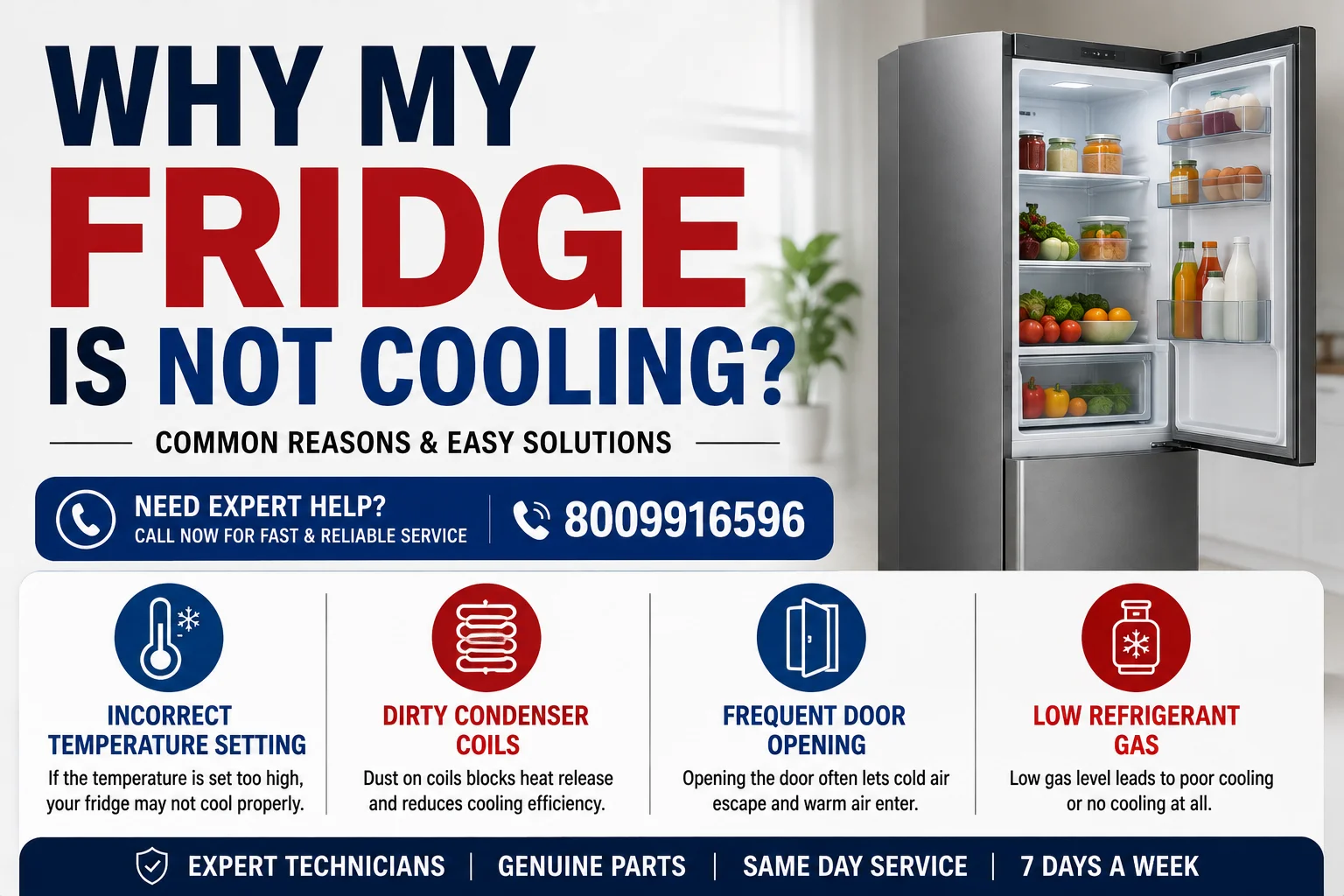
Why My Fridge Is Not Cooling?
A refrigerator that suddenly stops cooling can create an immediate problem at home. Milk may spoil, vegetables may lose freshness, frozen food may start thawing, and the appliance may continue running without actually maintaining the right temperature. If you are asking “why my fridge is not cooling?”,Simple problems like improper temperature settings or more complex problems with the compressor, fan motor, thermostat, sensor, control board, or refrigerant system could be the cause.
It is crucial to avoid making snap judgments on the cause. During refrigerator repair work, one common mistake is treating every cooling problem as a gas issue. In reality, several different faults can produce the same symptom. This guide explains the most common reasons why my fridge is not cooling, what you can check safely at home, and when professional diagnosis is required.
1. Incorrect Temperature Settings
Before assuming a major fault, check the temperature settings. Sometimes the refrigerator temperature may have been changed accidentally while cleaning the appliance or adjusting the control panel.
Most refrigerators should maintain a sufficiently cold temperature in the fresh-food compartment and freezing conditions in the freezer. If the temperature setting is too warm, the appliance may appear to be running normally while food does not stay properly chilled.
If you recently changed the settings, give the refrigerator enough time to stabilize. Avoid opening the door repeatedly while waiting because warm air entering the compartment can slow down temperature recovery.
This is one of the simplest answers to the question, why my fridge is not cooling, but it is often overlooked.
2. Dirty Condenser Coils
The refrigerator removes heat from inside the cabinet and releases it through its cooling system. Condenser coils play an important role in this process.
Over time, dust, dirt and pet hair can collect around the condenser area. When airflow is restricted, the refrigerator may struggle to release heat efficiently. This can result in poor cooling and longer compressor running time.
Homes in dusty environments may experience this problem more frequently. If the condenser area is accessible and your refrigerator manual allows cleaning, remove surface dust carefully with the appliance disconnected from power.
If cooling does not improve after cleaning, the problem may be elsewhere.
3. Faulty Evaporator Fan
In many frost-free refrigerators, the evaporator fan circulates cold air inside the appliance. If the cooling system is producing cold air but the fan is not moving it through the compartments, the refrigerator may feel warm in some areas.
A common situation is when the freezer appears colder than the refrigerator section. This can sometimes indicate an airflow problem.
The fan may stop working because of a faulty motor, ice obstruction, wiring issue or control problem. Since the exact cause requires inspection, this is usually not a problem to diagnose by simply replacing parts.
For customers wondering why my fridge is not cooling but the freezer is cold, airflow components are one area that should be checked.
4. Blocked Air Vents Inside the Refrigerator
Refrigerators require proper internal air circulation. Food containers pushed against vents can block the movement of cold air.
This is particularly common in busy households where the refrigerator is heavily loaded. Large containers placed near rear vents may prevent cold air from reaching other areas of the cabinet.
Try rearranging food items and avoid packing the refrigerator too tightly. Leave enough space around internal vents.
However, if the refrigerator remains warm even after improving airflow, the issue may involve the fan, damper system or cooling components.
5. Damaged Door Gasket
The rubber seal around the refrigerator door helps prevent warm outside air from continuously entering the cabinet.
If the door gasket is torn, loose, dirty or not sealing properly, the refrigerator may lose cooling efficiency. The compressor may also run for longer periods because the appliance is constantly trying to compensate for warm air entering inside.
Check whether the door closes evenly and whether anything is preventing it from shutting properly.
A damaged gasket can sometimes explain why my fridge is not cooling properly, especially when the appliance is running continuously but food is not staying cold enough.
6. Refrigerator Compressor Problems
The compressor is one of the main components in the refrigeration system. It helps circulate refrigerant through the sealed cooling system.
When the compressor develops a fault, the refrigerator may experience reduced cooling or complete cooling failure. However, a refrigerator that does not cool is not automatically suffering from compressor failure.
Starting relays, overload protectors, electrical connections and control components can also prevent the compressor from operating correctly.
This is why proper testing is important. Replacing a compressor without confirming the actual fault can lead to unnecessary repair expenses.
If you are repeatedly asking yourself why my fridge is not cooling even though it is making a running sound, a professional technician may need to check compressor performance and related electrical components.
7. Refrigerant or Sealed System Issues
A refrigerator requires the correct amount of refrigerant and proper pressure within its sealed system.
If there is a leak or another sealed-system fault, cooling performance may gradually decrease. Some customers notice that the refrigerator initially cools but later becomes less effective.
Refrigerant-related work should only be performed by a trained technician using appropriate equipment. Simply adding refrigerant without locating the actual cause may not provide a lasting solution if a leak exists.
When investigating why my fridge is not cooling, a technician should inspect the complete cooling system rather than automatically recommending gas charging.
8. Frost Build-Up Can Restrict Cooling
Excessive frost can block airflow inside frost-free refrigerators. The appliance may have a problem with its defrost system, including the defrost heater, sensor, timer or control circuit.
When ice builds around the evaporator area, cold air may not circulate correctly.
Temporary defrosting may improve cooling for a short period, but if the problem returns, the underlying defrost fault needs to be identified.
Recurring frost is a useful symptom to mention when requesting refrigerator repair.
9. Thermostat or Temperature Sensor Failure
The thermostat or electronic temperature sensor helps the refrigerator determine when cooling is required.
If these components provide incorrect information, the compressor may not run at the appropriate time or may stop before the desired temperature is reached.
Modern refrigerators often use electronic sensors and control boards rather than simple mechanical thermostats. Because different models use different systems, diagnosis depends on the refrigerator design.
This is another reason there is no single answer to why my fridge is not cooling. The same cooling complaint can have different causes depending on the appliance model.
10. Power Supply or Voltage Problems
Voltage fluctuations can affect refrigerator performance, particularly electronic components.
Sometimes the refrigerator may receive power but certain components may not operate correctly. Repeated voltage problems can also affect sensitive electrical parts over time.
If lights are working but cooling is inconsistent, do not assume the electrical supply is normal simply because the refrigerator turns on.
A technician may need to test the appliance’s electrical components, starting system and control operation.
What Should You Do When Your Fridge Is Not Cooling?
If you notice poor cooling, start with a few basic checks:
- Confirm that the power supply is working.
- Check the temperature settings.
- Ensure the refrigerator door closes properly.
- Avoid blocking internal air vents.
- Check for unusual frost accumulation.
- Listen for unusual sounds.
- Clean accessible dust around the condenser area if appropriate.
Avoid repeatedly switching the refrigerator on and off because this may not solve the underlying fault.
Also, do not attempt to open sealed refrigeration components or electrical sections without proper knowledge and equipment.
When Should You Call a Refrigerator Repair Technician?
You should consider professional inspection if:
- The refrigerator has completely stopped cooling.
- The compressor runs continuously.
- The freezer is cold but the refrigerator section is warm.
- There is excessive frost.
- You hear repeated clicking sounds.
- Cooling improves temporarily and then stops again.
- The appliance has already been restarted and basic checks have not helped.
A proper inspection should identify the fault before major parts are replaced.
Final Thoughts: Why My Fridge Is Not Cooling?
The answer to why my fridge is not cooling depends on what is happening inside the appliance. A simple airflow blockage, faulty fan, damaged door gasket, sensor issue, defrost problem, compressor fault or sealed-system issue can all affect cooling performance.
The most reliable approach is to observe the symptoms instead of guessing the repair. Note whether the freezer is cooling, whether the compressor is running, whether excessive frost is present and whether the problem started suddenly or gradually.
If basic checks do not restore normal cooling, arrange a professional diagnosis. Identifying the real cause early can help prevent unnecessary part replacement and give you a clearer understanding of the repair required.